
Do you have an account?
Why create an account?
After creating an account you will :
- have access to the “favourites” feature,
- be able to download certain data published by RTE,
- have access to forms (PKI certificate, EIC code, Customer questionnaire - KYC),
- have access to notifications.
If you are an RTE customer, feel free to contact your administrator so that he or she can give you access to your company’s services.
What are reserves and what purpose do they serve?
The French Energy Code provides that:
"The national transmission system operator monitors availability and implementation of the reserves required for operating the grid. […]"
The monitoring mission of reserves entrusted to RTE principally involves building available reserves within short time-frames to counteract incidents occurring in real time.
There are three types of reserves which can be successively applied:
- Frequency Containment reserve (FCR)
- automatic Frequency Restoration Reserve (aFRR)
- manual Frequency Restoration Reserve (mFRR)
RTE’s Frequency Containment Reserve (FCR) capacity requirement is established in accordance with the provisions of the “Joint proposal for dimensioning rules applicable to the FCR developed by all the mainland Europe TSOs in accordance with Article 153, paragraph 2, of the SOGL”.
The automatic Frequency Restoration Reserve (aFRR) and manual Frequency Restoration Reserve (mFRR) consist of FRR and are established in accordance with the requirements of ENTSO-E (European Network of Transmission System Operators) Policy 1, which stipulates that:
- after an incident, the transmission system operator must be able to restore the power exchanges of its control area within 15 minutes at the latest,
- that the sizing of reserves available in less than 15 minutes is done based on the assumption and expectation of the largest possible dimensionning incident.
For RTE:
- the positive dimensioning incident is the loss of the largest power generation module, which is a nuclear power plant type N4, for 1500 MW.
- the negative dimensioning incident is the loss of the largest consumption point wich is the Grand'Maison hydroelectrical power station in pumping, for 1280 MW.
To meet these requirements for mFRR, for which the sizing methodology is detailed in the Block Agreement (see the “Reference Documentation”, section at the bottom of the page), RTE proceeds through two types of calls for tenders: periodic calls for tenders and daily calls for tenders.
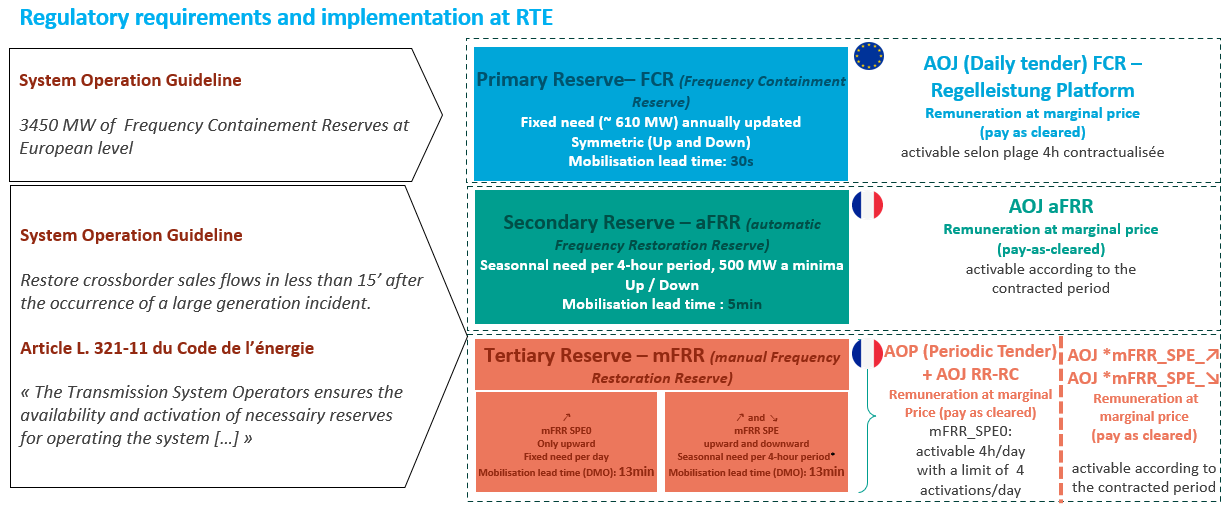
(*) The transition to the contractualization of the target reserve requirement of mFRR SPE will take place gradually, in accordance with the cost control measures.
The target requirements of tertiary reserve (mFRR), from 18 November 2026 to 31 March 2027 are as follow :
|
Plage . |
0h-04h |
04h-08h |
08h-12h |
12h-16h |
16h-20h |
20h-0h |
|
Target requirement of all upward mFRR |
1499 |
1668 |
2391 |
2398 |
1989 |
1410 |
|
Target requirement of downward mFRR |
1347 |
1302 |
1613 |
2054 |
1820 |
1433 |
The requested volume, broken down by mFRR products for daily and periodic tenders, is available on Balancing Capacities - RTE Services Portal
RTE contracts manual frequency restoration reserves through periodic calls for tenders and daily calls for tenders
Previously, RTE contracted manual frequency restoration and complementary reserves through an annual call for tenders process and, for the additional volume, through daily tender processes.
From January 1, 2026, the Electricity Balancing Guidelines no longer allows TSOs to issue calls for tenders with a contract period exceeding six months. Starting with version 5 of the mFRR-RR Rules, RTE has introduced a Periodic Call for Tenders (AOP) to replace the Annual Call for Tenders (AOA).
In its decision No. 2025-224, the CRE accepted the exemption requested by RTE to implement periodic calls for tenders covering periods corresponding to calendar quarters for the start-up of these AOPs. The volumes requested by RTE were 500 MW of upward manual frequency restoration reserve and 250 MW of upward complementary reserve. In its decision No. 2026-57, the CRE has requested RTE to submit, by the end of 2026, a new exemption to change the contract period for this periodic tender from a quarterly to a monthly basis. In its decision No. 2026-150, the CRE accepted the entry into force of the monthly periodic tenders with effect from the delivery day of October 1, 2026.
For the year 2026, the dates of the AOPs are as follows:
The different types of tertiary reserves must meet the following criteria:
*The term 'type of product' was added in the RR-RC V5 terms and conditions to introduce the contractualisation of a new mFRR product designed to meet RTE's mFRR downward requirement.
For daily tenders, balancing service providers must submit their capacity bids on the RACOON platform before 10 a.m. on D-1. The results are available at 10:30 a.m. Selected capacity bids are remunerated at the marginal price resulting from the tender.
For mFRR_SPE0 product (historical product), offered to periodic calls for tenders or daily calls for tenders (prior to the key date RT18), the first power range is indivisible and must be less than a maximum power level set at 150 MW.
For mFRR_SPE products (hourly intervals), if a bid is indivisible, the offered power must be less than a maximum power limit of 20 MW (subject to compliance with the mandatory conditions detailed in the SI Racoon guide, see paragraph below entitled 'information system and observability system') in particular, the maximum increment value set at 10 MW.
Parties awarded a mFRR call for tenders must make their capacities available on the balancing mechanism. This is why all tenderers must first be signatory to a participation agreement in manual frequency restoration and complementary reserves and a participation agreement as a balance responsible party before the deadline for submission of tenders in response to the periodic call for tenders. This condition must also be fulfilled before any participation in the daily call for tenders. All of the contract and technical information is available here: Becoming a balancing service provider.
If you are a customer connected to the grid, you are required to either become a balancing service provider, or to enlist the services of an aggregator to participate in the mechanism. Please find in the following link the list of participants with balancing entities approved for manual frequency restoration reserve.
To participate in manual frequency restoration tenders, you must:
- be able to participate in the balancing mechanism as a balancing service provider (see Becoming a balancing service provider)
- fill in annex 1 of the mFRR-RR terms and conditions to request participation in the manual frequency restoration and replacement reserve tenders terms and conditions and send it to marketservices@rte-france.com
- send the documents and information listed in the mFRR-RR terms and conditions
- submit your tenders via the RACOON platform to participate in the periodic and day-ahead call for tenders
If you are a successful tenderer (periodic and/or daily), declare before the beginning of the commitments, the elements constituting your certified capacities perimeter for manual frequency restoration according to modalities of terms and conditions.
Results of calls for tender
The results of mFRR-RR tenders are available on the RACOON platform for authorised parties.
In addition, RTE publishes the results of mFRR- RR calls on the dedicated Balancing Capacities page of the services portal.
Information system and observability system
A holder of a mFRR-RR contract must:
- Obtain all the required access as a balancing service provider: Becoming a balancing service provider
- Apply the IT rules: RACOON - Guide SI mFRR RR - V1.6.5
- Apply the IT rules: Guide SI NER
Reference documentation
- Terms and Conditions relating to the manual frequency restoration and complementary reserves. Version 6 applicable as of 1 April 2026
- Load-Frequency Control Block operational agreement. Version 6 applicable as of 1 April 2026
Contacts
For any queries, please email your usual sales representative or marketservices@rte-france.com (RTE Sales Division).